There’s a particular kind of quiet that shows up in organizations right before something breaks.
Meetings run smoothly. Nobody pushes back. Decisions are nodded through. The tone is polite, agreeable—even calm. And yet, underneath that calm is a growing sense that something isn’t right.
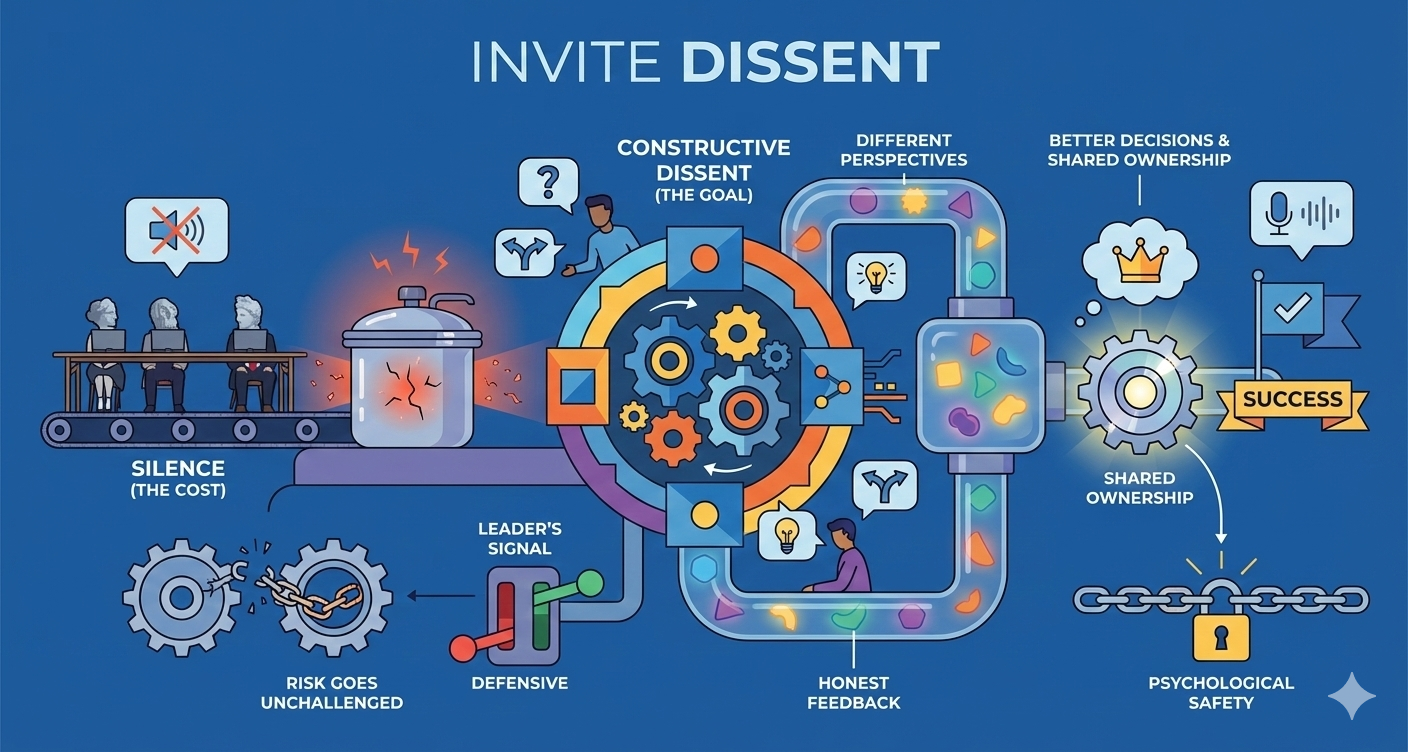
That silence isn’t alignment. It’s avoidance.
Organizations often confuse harmony with health. In reality, the absence of dissent usually signals something far more dangerous: people no longer believe it’s safe—or worthwhile—to speak honestly.
Psychological Safety Is Not Comfort
Psychological safety is frequently misunderstood as creating environments where no one feels uncomfortable. That interpretation misses the point entirely.
Real psychological safety is the confidence that you can speak the truth without fear of retaliation. It’s the belief that raising a concern, questioning a decision, or offering an unpopular perspective won’t quietly damage your standing.
Discomfort is not the enemy here. Suppression is.
If people feel safe only when they agree, the organization isn’t safe—it’s fragile.
Silence Is a Lagging Indicator
By the time dissent disappears, the cost has already been paid.
People don’t stop speaking up because they suddenly lack opinions. They stop because past attempts were ignored, deflected, or (not so) subtly punished. Over time, the lesson becomes clear: it’s easier to stay quiet.
This is how organizations drift. Risks go unchallenged. Weak assumptions harden into policy. Small issues compound until they become crises that seem to appear “out of nowhere.”
They didn’t come out of nowhere. They just weren’t voiced anymore.
Leaders Shape the Signal
Dissent doesn’t vanish on its own. It responds to incentives—spoken and unspoken.
When leaders react defensively to challenge, even unintentionally, they teach people what not to do. When disagreement is reframed as negativity, disloyalty, or “not being a team player,” silence becomes rational behavior.
Inviting dissent requires more than saying, “Any concerns?” at the end of a meeting.
It requires demonstrating—consistently—that disagreement is not a career-limiting move.
That means listening without interrupting. Asking follow-up questions instead of counterarguments. Acknowledging when a point changes your thinking. And, critically, avoiding punishment disguised as feedback.
Dissent Is a Health Signal
Dissent isn’t noise in the system. It’s instrumentation.
When people challenge ideas openly, it usually means two things are true at the same time: they care about the outcome, and they believe the environment can handle honesty.
Healthy teams don’t avoid scrutiny; they invite it. Ideas are tested early. Assumptions are stress-loaded. Weak reasoning is exposed while the cost of change is still low. This is how strong ideas get stronger—not by protection, but by pressure.
An idea that improves when challenged is resilient.
An idea that collapses under scrutiny was already failing—it just hadn’t been discovered yet.
Suppressing dissent doesn’t protect ideas. It merely delays their reckoning.
You might see this most clearly in technical decisions. A team agrees on an architectural approach—say, a caching strategy that assumes traffic patterns will remain stable. One engineer raises a concern: certain edge cases could invalidate the cache and cause cascading load under peak conditions. The idea is challenged, stress-tested, and partially reworked. Maybe the concern proves unfounded; maybe it exposes a real flaw. Either way, the outcome is stronger. If the idea survives scrutiny, confidence increases. If it doesn’t, the failure is cheap and contained. What would have been a production incident becomes a design conversation instead.
Scrutiny Is Cheaper Than Failure
Every unchallenged decision carries hidden interest. The longer it goes unquestioned, the more expensive it becomes to unwind.
Dissent front-loads that cost. It feels slower in the moment—more discussion, more friction—but it prevents far more expensive failures later. Rework, reputational damage, missed signals, and post-mortems that begin with “in hindsight” are often the price of earlier silence.
Strong organizations learn this lesson early: challenge now, or pay later.
Productive Tension Is a Feature
High-performing teams aren’t conflict-free. They’re conflict-capable.
They know how to disagree without personalizing it. They understand that tension, when handled well, sharpens decisions rather than derailing them. The goal isn’t consensus at all costs; it’s clarity and shared ownership of the outcome.
When dissent is normalized, people argue ideas instead of protecting themselves. The work improves because more of reality is allowed into the room.
A Brief Word on “Dissent” (Because Language Matters)
“Dissent” has an unfortunate reputation. It sounds combative, even rebellious. In practice, it’s usually far more ordinary—and far more useful.
Depending on the context, dissent might look like: pushback, challenge, critique, questioning, counterpoint, skepticism, debate, friction, disagreement, tension, scrutiny, or simply thinking out loud in public.
Call it whatever you like. What matters is that it exists—and that it’s safe.
Because the absence of dissent doesn’t mean everyone agrees.
It usually means they’ve stopped trying.
What to Watch For
If you want to know whether dissent is truly welcome, don’t listen to what leaders say. Watch what happens after someone disagrees.
Does the conversation slow down—or shut down?
Does the dissenter get labeled as “difficult”?
Do future meetings grow quieter?
Culture is revealed in these moments.
Invite Dissent—Deliberately
Inviting dissent isn’t about encouraging conflict for its own sake. It’s about refusing the false comfort of quiet agreement.
It’s about recognizing that silence is expensive, even when it feels efficient. Especially when it feels efficient.
The healthiest organizations aren’t the ones with the fewest disagreements. They’re the ones where disagreement is safe, expected, and ultimately productive.
Because the goal isn’t to avoid discomfort.
It’s to avoid being wrong in silence.